The report provides a scientific basis for the introduction of a child-friendly justice system in Liechtenstein. Among other things, it recommends the introduction of independent legal representation for children, as well as binding standards for child-friendly hearings. In addition, it proposes clarifying roles within Child and Youth Services to prevent conflicts of interest.
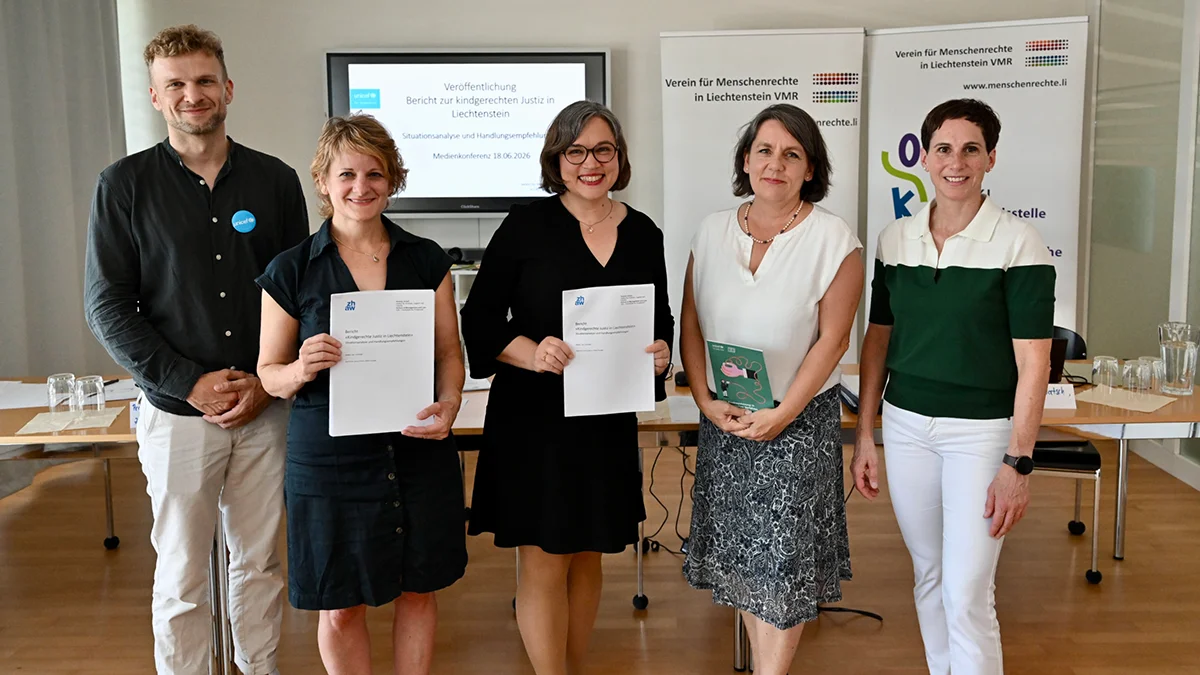
The Liechtenstein Human Rights Association (LHRA) and the Ombudsman’s Office for Children and Young People (OSKJ) today presented the report “Child-Friendly Justice in Liechtenstein – Situation Analysis and Recommendations for Action.”The study was conducted by the Zurich University of Applied Sciences (ZHAW), with technical guidance and co-funding from UNICEF Switzerland and Liechtenstein.
A child-friendly justice system is a central component of implementing the right to be heard and to participate, as set forth in Art. 12 of the Convention on the Rights of the Child. It ensures that children and adolescents are provided with age-appropriate information, are heard, and are involved in decisions that directly affect their lives. In its 2023 report, the Committee on the Rights of the Child strongly recommended that Liechtenstein improve children’s rights to be heard. This study is the first comprehensive examination of how well the Liechtenstein judiciary system implements children’s rights to be heard and what measures are needed to further ensure their implementation.
Isolated initiatives, but a lack of binding standards
The analysis shows that Liechtenstein has some legal frameworks and institutional approaches in place. At the same time, however, there is a lack of structures to consistently and effectively implement children’s rights to participation. The children and adolescents surveyed said that, although they were listened to, they did not always feel that they were actually heard or taken seriously. In addition, shortcomings were identified in the provision of information, preparation, and support for children involved in proceedings.
The most important recommendations include introducing independent legal representation for children, improving the information provided and support given to children during proceedings, further standardizing child-friendly hearings, reviewing the dual role of Child and Youth Services, strengthening institutional collaboration, and mandating continuing education for professionals. The legal requirements should also be developed further and the Ombudsman’s Office for Children and Young People strengthened in the long term.
The report provides a well-founded theoretical framework for understanding a child-friendly justice system and combines this with practical insights drawn from interviews with professionals, affected persons and international experts. Based on this, specific recommendations for action were developed for government agencies, the judiciary, policymakers, and other institutions. The goal is to use this as a basis for implementing specific reform measures to sustainably strengthen the rights of children and adolescents within the justice system.
Six core elements of a child-friendly justice system
- Legal representation for children: Children should have access to independent, specialized, and easily accessible legal representation.
- Information and advice: Children must be informed and advised about their rights, the procedures involved and their options in a manner appropriate to their age and level of maturity before, during and after the entire process.
- Child-friendly hearings: Every child, regardless of age, should have the right to be heard. The hearing must be conducted in a child-friendly manner, the opinions expressed must be given due consideration, and the decisions made must be supported by clear and understandable reasoning.
- Interdisciplinary collaboration: A child-friendly justice system requires structured collaboration among legal, psychosocial and medical professionals.
- Structural and institutional conditions: Such proceedings must always be given priority. In addition, independent complaint and monitoring bodies are needed.
- Continuing education for professionals: All professionals involved should have a solid understanding of children’s rights, child development and age-appropriate communication, and should participate in regular continuing education.